8 Best Slow Masticating Juicers (October 2026)
The best slow masticating juicers include the Kuvings AUTO10 Hands-Free for large hands-free batches, the Canoly C16 3-in-1 Juicer for a wide feed throat, and the Omega 43 RPM Compact Vertical Juicer for a compact vertical setup.
On this page (4 sections)
The Kuvings AUTO10 Hands-Free is the best slow masticating juicer for large batches, with a 3-liter hopper and screens for juice, smoothies and sorbet. Canoly offers a 6-inch feed throat, while Omega's 43 RPM model suits a compact vertical setup.
Slow masticating juicers use an auger to press produce, but the day-to-day experience varies. Hopper size, counter space, pulp control and cleanup can matter as much as the juicing mechanism.
For a broader look at machine styles, start with our cold press juicer machine guide. If you want the mechanism explained first, read what a masticating juicer does.
Our picks at a glance
-
1

-
2

-
3
 Best for a compact vertical setup
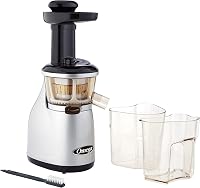
Omega 43 RPM Compact Vertical Juicer
8.1/10 our score
See it on Amazon
Which slow masticating juicers fit different kitchens?
The AUTO10 is the strongest fit for large hands-free batches, while the other picks focus on feed opening, pulp settings, cleanup or added uses. Choose the feature that will change your routine most.
Kuvings AUTO10 Hands-Free: Best for large hands-free batches
- 3-liter hopper
- Auto-cutting blade and hands-free feeding
- Juice, smoothie and sorbet screens
- 240W motor
A large hopper and auto-cutting blade help reduce prep for a batch. The included screens also support smoothies and sorbet.
Pros
- Large hopper for batches
- Hands-free feeding
- Three included screens
Cons
- Taller than compact vertical models
- Warranty coverage is limited to the US and Canada
The AUTO10 is the clearest fit if you want to load a batch and step away while it feeds. Its 3-liter hopper and auto-cutting blade are designed for whole fruits and vegetables, and the 240W motor is rated for up to 45 continuous minutes.
Kuvings includes juice, smoothie and sorbet screens, giving you options beyond standard juice. The unit measures 10 x 8 x 19 inches, so check the height below your cabinets before setting a regular spot.
Removable parts and a cleaning tool are included. The redesigned pulp chute helps prevent clogging, though fibrous produce can still need attention during a long batch.
Choose it for larger recipes and hands-free loading. Its US and Canada warranty coverage matters if you live elsewhere, because coverage and replacement parts are limited to those countries.
Canoly C16 3-in-1 Juicer: Best for a wide feed throat
- 6-inch feed throat
- 90 oz hopper
- Juice and sorbet strainers
- Nut milk capability
The wide feed throat accommodates whole fruits such as apples and pears. Its two strainers support juice, sorbet and nut milk.
Pros
- Wide feed throat
- Large hopper
- Two strainer options
Cons
- Tall body needs cabinet clearance
- Nut milk preparation may take more cleanup
Canoly's C16 is built around a 6-inch feed throat that can take whole apples and pears, plus large celery bunches. That can cut prep for suitable ingredients, though long produce may still need trimming to fit safely.
The 90 oz hopper is sized for larger batches, and two strainers cover juice and sorbet. The machine can also make nut milk, which makes the C16 a flexible option if you want more than fruit and vegetable juice.
Its body is 17.32 inches tall and nearly 7 inches wide. Measure both cabinet height and counter depth before choosing it, and check how you'll store the removable parts.
Omega 43 RPM Compact Vertical Juicer: Best for a compact vertical setup
- 43 RPM operation
- No-drip juice tap
- Automatic pulp ejection
- 150W motor
This Omega uses a low-speed vertical design with a no-drip tap for mixing juice or removing the cup. Its stated dimensions are relatively low, but it is wider than some vertical models.
Pros
- Low stated operating speed
- No-drip tap
- Automatic pulp ejection
Cons
- Wide footprint for a vertical juicer
- Interlock must be engaged to run
Omega's 43 RPM Compact Vertical Juicer suits buyers who want a low-speed machine with a no-drip tap. Close the tap while juicing to mix juice or nut milk, then close it after juicing before lifting away the cup.
The model also has automatic pulp ejection and a dual-edge auger. Omega says its system strains more juice and breaks down fiber for a smoother juice.
Its dimensions are 9.14 x 15.67 x 9.49 inches, which means it is relatively low but takes up more width than the other vertical picks. The interlock must be engaged for the juicer to operate.
Hurom H320 Cold Press Juicer: Best for adjustable pulp

- Fine and coarse strainers
- Pulp control lever
- Self-feeding hopper
- Quiet AC motor
Fine and coarse strainers let you adjust pulp to suit the drink. Its self-feeding hopper is designed for larger loads and whole produce.
Pros
- Adjustable pulp options
- Self-feeding hopper
- Quiet motor
Cons
- Hand wash only
- Juice container capacity is 0.5 liters
The Hurom H320 is a practical pick if pulp level is a deciding factor. Its fine and coarse strainers work with a control lever, so you can adjust the texture.
A self-feeding hopper is designed to hold whole produce and allow more ingredients to be added while the machine runs. Hurom describes the AC motor as quiet, a useful feature when the kitchen is near bedrooms or a shared living space.
The body measures 8 x 8 x 16 inches. Hurom specifies hand washing for care, and its listed capacity is 0.5 liters, so consider how often you'll need to empty the container during a larger batch.
Omega VRT350 Vertical Juicer: Best for reverse clearing
- 80 RPM operation
- Reverse setting
- Two-stage juicing
- Two 64 oz containers
The reverse setting can help when something gets stuck. Its two-stage process presses pulp again before ejection.
Pros
- Reverse setting
- Two-stage juicing
- Separate juice and pulp containers
Cons
- Hand wash only
- Heavier than the compact vertical option
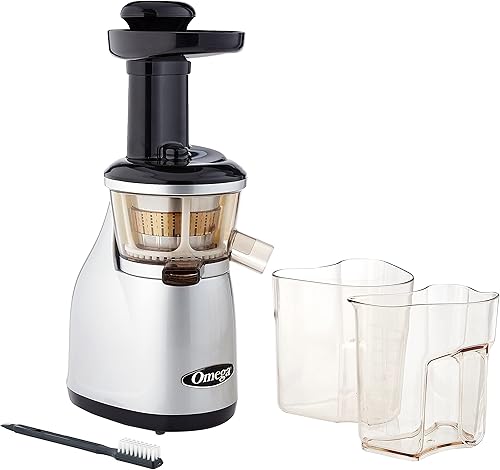
The Omega VRT350 is a practical pick if you want a reverse setting for stuck produce. Its controls include on, off and reverse, and the two-stage process presses ingredients before pulp is ejected.
Two 64 oz containers separate juice from pulp. The 18 lb machine is heavier than the smaller vertical Omega above.
Omega describes the 80 RPM system as squeezing rather than grinding. The model is hand wash only, so account for rinsing and brush work after each use.
Hurom H400 Cold Press Juicer: Best for fewer strainer parts

- Self-feeding hopper
- Strainer-free chamber set
- Quiet motor
- Two-part auger
The strainer-free chamber set is designed to reduce scrubbing around a mesh screen. A self-feeding hopper supports larger ingredient loads.
Pros
- Strainer-free chamber set
- Self-feeding hopper
- Quiet motor
Cons
- Tall design needs clearance
- Hand wash only
The Hurom H400 is aimed at buyers who want a strainer-free chamber set. Hurom describes this design as avoiding a traditional strainer, which may mean less scrubbing around a mesh screen after juicing.
Its self-feeding hopper can take more ingredients without chopping them first, and the quiet motor suits early morning use. The two-part auger is designed to strain juice with low pulp.
At 18.5 inches tall, it needs more vertical clearance than the H320. Hurom specifies hand washing, so the chamber design does not remove the need to clean removable parts.
Omega NC1000HDS Slow Juicer: Best for more than juicing

- 80 RPM operation
- Reverse function
- Pasta and nut butter attachments
- Top-rack dishwasher-safe removable parts
This horizontal Omega is a multi-use nutrition system for buyers who want more than juice. It can also extrude pasta, grind coffee and spices, and make nut butter.
Pros
- Multiple food-preparation uses
- Reverse function
- Removable parts are top-rack dishwasher safe on cold cycle
Cons
- Wide horizontal footprint
- More parts and uses to store
The Omega NC1000HDS is the most versatile choice here if you want a machine for food prep beyond juice. It can extrude pasta, grind coffee and spices, make nut butter and prepare baby food.
It runs at 80 RPM and includes a reverse function. Removable parts are top-rack dishwasher safe on a cold cycle.
This horizontal model measures 18.5 inches wide, so plan for counter room and storage for its parts. Choose it for the extra functions and check that the footprint fits your space.
Kuvings AUTO9 Hands-Free: Best for hands-free juicing in less space

- 2-liter auto-cut hopper
- 60 RPM operation
- 200W motor
- 11.9 lb weight
The AUTO9 uses an auto-cut hopper for hands-free feeding in a narrower footprint than the AUTO10. It includes a sorbet strainer and cleaning tools.
Pros
- Hands-free feeding
- Smaller hopper than AUTO10
- Included cleaning tools
Cons
- Hand wash only
- Warranty coverage is limited to the US
The Kuvings AUTO9 suits buyers who want hands-free feeding in a smaller footprint than the AUTO10. Its 2-liter auto-cut hopper is smaller, and the machine measures 8.9 x 7.6 x 18.3 inches.
Kuvings says the AUTO9 presses at 60 RPM and includes a sorbet strainer and cleaning tools. At 11.9 lb, it is lighter than the AUTO10, which may make moving it easier when counter space is shared.
The AUTO9 is hand wash only. Warranty coverage and replacement parts are limited to the US, so check regional support before choosing it.
How did we compare these slow juicers?
We compared the features that affect daily use: feeding style, hopper size, machine footprint, pulp options, cleanup and other uses. Our score weighs specs and features against what shoppers seeking a slow masticating juicer are likely to need.
A large hopper is helpful for batch juicing, but it does not tell you whether the machine fits below your cabinets. Measure the space where you plan to keep it, including room to lift or remove the hopper.
What should you compare before choosing a slow masticating juicer?
Compare the feed system, cleanup steps and storage space before choosing a slow masticating juicer. A machine that suits your usual ingredients is easier to work into a regular routine.
Does a wide chute matter on a slow masticating juicer?
A wide feed throat can reduce chopping for produce that fits through it. Canoly's C16 has a 6-inch feed throat, while the AUTO10 and AUTO9 use auto-cutting hoppers.
Even a wide opening does not mean every ingredient can go in whole. Trim produce when needed, and follow the instructions for safe feeding.
For more on this tradeoff, see whether juicer feed chute width matters.
Do slow masticating juicers make less pulp?
Pulp control depends on the model's strainers and settings. The Hurom H320 offers fine and coarse strainers with a control lever, while the Omega 43 RPM model uses a dual-edge auger and screen.
Texture also depends on the ingredients and how you prepare them. If you want juice with more pulp, check whether the model offers a coarse setting before you buy.
How much counter space does a slow juicer need?
The footprint and height both matter, especially for tall self-feeding models. The AUTO10 is 19 inches tall, while the Omega 43 RPM model is about 9.5 inches tall and over 15 inches wide.
Measure the counter area and the space under any cabinets. Leave room to remove the hopper and rinse parts without moving the whole machine each time.
How should you plan for cleanup?
Check whether the model has a mesh screen, a cleaning tool, dishwasher-safe parts or a strainer-free chamber. Those details affect the brush work and rinsing after each batch.
The AUTO10 includes a cleaning tool, the H400 uses a strainer-free chamber set, and the NC1000HDS has removable parts that are top-rack dishwasher safe on a cold cycle. Read the care instructions before washing parts in a dishwasher.
Our guide to cleaning a masticating juicer explains how to handle the auger, screen and pulp path. For recurring jams, see why a juicer keeps clogging.
Which slow masticating juicer should you choose?
Choose the Kuvings AUTO10 for a 3-liter hopper and hands-free batches, or the Canoly C16 if its 6-inch feed throat better fits your prep routine. Pick the Hurom H320 for adjustable pulp and the Omega NC1000HDS for added food-prep uses.
Before you decide, match the machine's dimensions and cleaning steps to the space and time you have. If you are comparing slow and fast extraction styles, read our cold press vs centrifugal juicer guide.
Our top 3 picks at a glance
-
1
-
2
-
3
Best for a compact vertical setup
Omega 43 RPM Compact Vertical Juicer
8.1/10 our score
See it on Amazon
Frequently asked questions
What is a slow masticating juicer?
A slow masticating juicer presses produce with an auger at a lower speed than a typical centrifugal juicer. Models differ in feeding style, screens and pulp controls, so compare the parts that affect your routine.
See our guide to how masticating juicers work for the basic mechanism.
Is a slow masticating juicer the same as a cold press juicer?
The terms often describe auger juicers that press produce slowly, though brands use them in different ways. Check the mechanism and features instead of relying on the label alone.
Our cold press juicer machine guide explains what to compare.
Are slow juicers hard to clean?
Cleanup depends on the number and shape of removable parts, especially screens and pulp outlets. Some models include cleaning tools or use a strainer-free chamber, while others need hand washing.
Our masticating juicer cleaning guide walks through the parts to rinse.
Should you choose a hands-free juicer?
A hands-free model can reduce how much you need to feed produce during a batch, but it still needs loading and cleanup. Compare hopper size with your usual batch and counter height.
A wide chute or large hopper may also reduce chopping, depending on the produce.