Nama J2 vs Kuvings AUTO10: Hands-Free Juicer (October 2026)
Choose the Nama J2 for a shorter, lighter juicer; choose the Kuvings AUTO10 for a larger stated hopper and 3 included screen types. Both feed produce from a hopper, so your recipe size, available space and planned uses should guide the choice.
On this page (8 sections)
- Nama J2 vs Kuvings AUTO10: which should you choose?
- How do the hoppers affect prep?
- Which juicer fits your counter?
- What is different about cleanup?
- Which screens and parts suit your recipes?
- What common buying mistakes should you avoid?
- How should you set up either juicer?
- Should you choose the Nama J2 or Kuvings AUTO10?
The Nama J2 vs Kuvings AUTO10 choice comes down to fit and batch size: choose the J2 for a shorter, lighter machine, or the AUTO10 for a larger stated hopper and 3 screen types. Both use self-feeding hoppers, so your routine can involve less piece-by-piece feeding.
The J2's stated capacity is 1.9 lb, while the AUTO10's is 3 L. Because these figures use different units, treat them as product-specific capacity descriptions, not as a direct ratio.

Nama J2 vs Kuvings AUTO10: which should you choose?
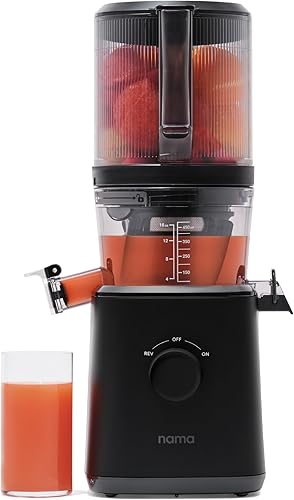
Choose the J2 if counter height and easier lifting matter most; choose the AUTO10 if you want a larger hopper and more screen options. The AUTO10 is suited to larger recipe loads, while the J2 has a more compact height and lower weight.
Both are corded electric, self-feeding cold press juicers. NAMA describes loading a whole recipe into the J2 hopper, while Kuvings describes the AUTO10 as having an auto-cutting blade and a 3 L hopper.
The motors differ: the J2 has a 200 W motor that runs at 50 RPM, while the AUTO10 has a 240 W motor and is described as running for up to 45 continuous minutes. Those specifications alone do not settle yield or juice quality, so decide first by the jobs, space and parts that matter in your kitchen.
Who should buy the Nama J2?
Buy the J2 if you want hands-free feeding in a shorter, lighter machine and your usual recipe fits its stated capacity. Its 17.7 in height is easier to accommodate under low cabinets than the AUTO10's 19 in height.
The J2 comes with a juice container, pulp container, coarse strainer and juice strainer. NAMA recommends it for juice, sauce, smoothies and sorbet, so it can suit you if you want those uses and don't need the AUTO10's separate screen set.
It has one speed. Skip the J2 if adjustable speeds are a must for you, or if your recipes regularly call for a larger load than its stated 1.9 lb capacity.
The juicer weighs 12.1 lb, which also makes it the more manageable option if you expect to move it between the counter and a cupboard. It still needs enough room for its hopper, containers and disassembled parts during use and cleanup.
Who should buy the Kuvings AUTO10?
Buy the AUTO10 if you make larger batches or want separate screens for juice, smoothies and sorbet. Its 3 L hopper is designed for larger recipe loads, and the auto-cutting blade adds to its hands-free setup.
Its motor is rated at 240 W. Kuvings describes it as handling hard produce such as kale, beets and carrots, and running for up to 45 continuous minutes for larger batches.
Skip it if your counter has tight overhead clearance or you need a lighter machine to move often. At 19 in high and 15.5 lb, it is taller and heavier than the J2 even though it is narrower from side to side.
Kuvings states a 15-year assurance for the AUTO10, with coverage and replacement parts valid only in the US and Canada. If you live elsewhere, confirm warranty support before buying.
How do the hoppers affect prep?
Both hoppers are designed to reduce repeated feeding, and the AUTO10 has the larger stated capacity. Neither hopper means every ingredient can go in whole without preparation.
NAMA describes loading the J2 with a whole recipe, and Kuvings describes the AUTO10 as accepting whole fruits and vegetables through its auto-cutting setup. Follow each machine's instructions for cutting produce that is too large, firm or awkwardly shaped.
A hands-free hopper works best when the produce is prepared in a way the machine can process steadily. Avoid packing in more than the instructions allow or mixing a full hopper with ingredients that need different preparation.
If hopper access is central to your choice, our guide to why feed chute width matters explains how to think about produce size and counter clearance. For a wider look at the category, see our cold press juicer machines buying guide.
Which juicer fits your counter?
The J2 is shorter and lighter, while the AUTO10 is narrower from side to side. Measure width, depth and overhead clearance instead of choosing from one dimension.
The J2 measures 9.8 in wide, 9 in deep and 17.7 in high. The AUTO10 measures 8 in wide, 10 in deep and 19 in high.
That makes the AUTO10 1.8 in narrower, but 1 in deeper and 1.3 in taller. A narrow counter may favor its width, while a shallow shelf or low cabinet may favor the J2.
Before buying, measure the assembled machine's spot and leave room to load the hopper, place the juice container and remove parts for washing. If you plan to store the juicer after each use, consider whether you are comfortable lifting and carrying it.
What is different about cleanup?
Both models require hand washing, but their cleanup features differ. The J2 includes quick-release parts and a brush, while the AUTO10 includes a cleaning tool and has a redesigned pulp chute.
Rinse parts soon after juicing so pulp does not have as much time to dry. Use the brush or cleaning tool to clear residue from strainers and narrow areas, then let parts dry before storing them.
The AUTO10's Smart Cap detaches for cleaning. Its pulp chute is designed to help prevent clogging, but you still need to clear the chute and rinse the removable parts after use.
Neither model is dishwasher-safe according to the stated care instructions. Check the juicer parts dishwasher guide before putting any part in a dishwasher, and see our part-by-part masticating juicer cleaning guide for a practical cleanup routine.
Which screens and parts suit your recipes?
The AUTO10 has separate juice, smoothie and sorbet screens; the J2 includes coarse and juice strainers. Pick the setup that matches the preparations you expect to make most often.
The J2 also includes juice and pulp containers, a container lid, a pusher and a spinning brush. NAMA recommends it for juice, sauce, smoothies and sorbet, though its included strainers differ from the AUTO10's named screens.
The AUTO10 comes with a juice container, pulp container, cleaning tool and juice, smoothie and sorbet screens. Those extra screen types make it the clearer match if you want one machine for several textures.
The AUTO9 is another self-feeding option with a 2 L hopper and a narrower body than the AUTO10. Its included components include a sorbet strainer and cleaning brush, so it can suit you if that middle-size capacity and setup are enough.
What common buying mistakes should you avoid?
Compare the machines by your actual recipes and kitchen measurements, not by one headline specification. Capacity units differ, wattage does not guarantee juice yield, and a wide hopper does not eliminate all prep.
First, don't treat 1.9 lb and 3 L as directly comparable measurements. Think about how much produce your regular recipe uses and whether you prefer a larger hopper, then check the maker's instructions for load limits.
Second, don't assume whole-produce feeding means every fruit or vegetable goes in uncut. Large or firm pieces may need preparation, and overfilling can make feeding and cleanup harder.
Third, don't choose by width alone. The AUTO10 is narrower, but it is deeper, taller and heavier than the J2, so check the complete footprint and overhead room.
Finally, don't overlook the regional warranty terms. The AUTO10's stated coverage and replacement parts are limited to the US and Canada, while the J2's region details are not specified here.
How should you set up either juicer?
Set up the juicer on a level counter with room for the hopper, containers and cleanup parts. Assemble it according to its included instructions before adding produce.
Keep the juice and pulp containers in place before starting, and make sure the lid and removable parts are seated as directed. For your first recipe, prepare produce in manageable pieces and avoid filling beyond the machine's instructions.
Load a balanced recipe rather than forcing a large amount into the hopper at once. Stay nearby for the first run so you can see how the produce feeds, then use the machine's directions if anything stalls.
After juicing, switch the machine off and unplug it before removing parts for washing. Rinse the parts promptly, clear pulp with the included tool and allow the pieces to dry fully.
Should you choose the Nama J2 or Kuvings AUTO10?
Choose the Nama J2 for a shorter, lighter juicer and recipes that fit its hopper; choose the Kuvings AUTO10 for its 3 L hopper and juice, smoothie and sorbet screens. The J2 scores 8.5 and the AUTO10 scores 8.4 for this comparison, based on how their features fit these needs.
Pick the AUTO9 if its 2 L hopper and narrower body are a better match for your counter. It scores 7.7 and has a 10-year assurance, with stated coverage limited to the US.
If self-feeding matters more than choosing between these two models, compare other options in our best hands-free juicers guide.
Frequently asked questions
Is the Nama J2 or Kuvings AUTO10 better for large batches?
The AUTO10 is designed around larger recipe loads and has a stated 3 L hopper. The J2 has a stated capacity of 1.9 lb, so don't compare the numbers as an exact volume ratio because they use different units.
Choose based on how much produce you load per recipe and whether the AUTO10's larger hopper fits your counter.
Do the Nama J2 and Kuvings AUTO10 both feed themselves?
Yes. Both have self-feeding hoppers designed to take a recipe load, which cuts down on adding produce one piece at a time while the machine runs.
The AUTO10 also has an auto-cutting blade.
For either model, follow its instructions for preparing different kinds and sizes of produce.
Which juicer is smaller, the J2 or AUTO10?
The Nama J2 is shorter and lighter: it measures 17.7 in high and weighs 12.1 lb. The AUTO10 is 19 in high and weighs 15.5 lb, though it is narrower from side to side.
Measure counter depth, width and overhead clearance before choosing.
Can the Kuvings AUTO10 make smoothies and sorbet?
Yes. It includes juice, smoothie and sorbet screens, and its recommended uses include fruits, nuts and vegetables.
The J2 is recommended for juice, sauce, smoothies and sorbet, and comes with juice strainers.
Compare the included parts with the preparations you expect to make.
Is the Nama J2 easier to clean than the AUTO10?
Both have removable parts and cleaning tools, and both require hand washing according to their care instructions. The J2 has quick-release parts and a cleaning brush; the AUTO10 has a cleaning tool, removable parts and a redesigned pulp chute.
Rinse parts soon after juicing and use the included tool to clear pulp.