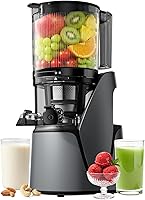
Hurom H-AA Slow Juicer Review: Worth It? (November 2026)
The Hurom H-AA is worth buying if you want a quiet, blade-free slow juicer for leafy greens, nuts and soybeans, and you don't mind hand-washing its parts. Buy it for its low-speed auger and adjustable pulp; skip it if you need a wide feed chute or dishwasher-safe cleanup.
On this page (8 sections)
The Hurom H-AA is the slow juicer to buy for leafy greens, nuts and soy milk, as long as small batches and hand washing don't put you off. Its 150 W motor stays quiet, the pulp lever lets you choose texture, and the blade-free auger presses gently instead of shredding.
This Hurom H-AA slow juicer review covers what the specs mean for daily use, where the machine earns its place and where the alternatives fit better.
The Hurom H-AA at a glance
The H-AA is a compact, blade-free slow juicer built around Hurom's Alpha Technology. It presses fruit, vegetables, leafy greens, nuts and soybeans, and it can also make ice cream in the same chamber.
Hurom describes Alpha Technology as its optimized juicing system, with easier cleaning and the ice cream option built in.
Hurom H-AA Slow Juicer: Best for leafy greens and soy milk

- 150 W quiet motor
- 500 ml chamber
- Slow Squeeze low-speed auger
- Fine and coarse strainers plus pulp lever
A blade-free slow juicer that presses greens, nuts and soybeans gently. The pulp lever and two strainers let you dial in texture, and cleanup is hand wash only.
Pros
- Quiet 150 W motor suits early mornings
- Pulp control lever with fine and coarse strainers
- Handles leafy greens, nuts and soybeans
- Can make ice cream in the chamber
- No blades or sharp parts
Cons
- 500 ml chamber means small batches
- Hand wash only
- No wide feed chute, so produce needs cutting
At 16 inches tall and 10.8 pounds, it sits upright like a small appliance tower rather than a wide box. That shape saves counter depth but needs overhead clearance, so measure the gap under your upper cabinets first.
The body is polished white over an ABS housing, with stainless steel in the blade and press components. The chamber holds 500 ml and the whole unit runs on a corded electric supply with simple button controls.
It also arrives with a full set of extras rather than bare parts: a drying rack, large and small cleaning brushes, a pusher, a spinning brush and separate juice and pulp containers. Those extras matter for daily use, because a slow juicer lives or dies on how easy it is to take apart and dry.
The included components also cover an auger, a twin auger, a drum, a bowl and fine, coarse and ice cream strainers. Hurom says its slow juicers are 100% BPA free and come with no blades or sharp parts.
For a kitchen used by the whole family, that last detail is a real safety point rather than marketing.
Who should buy the Hurom H-AA?
Buy it if your juicing leans toward greens, nuts and soy, and you want one machine that handles all three without heat. The low-speed auger and the two strainers give you more control than a basic centrifugal juicer offers.
Hurom lists fruits, cruciferous vegetables, leafy greens, nuts and soybeans among its uses, and adds milk, tofu and ice cream to the list of foods it can make.
It also suits anyone who juices early. Hurom built the motor to run quietly, so starting a green juice at 6 AM won't wake the house the way a high-speed centrifugal model can.
The low 150 W draw is consistent with a machine that presses slowly rather than spins fast.
The adjustable pulp is another draw for households with mixed tastes. One person may want smooth juice with the fine strainer and the lever set low, while another wants a fuller texture from the coarse strainer.
Having both in the box means you don't buy a second machine to get that choice.
Skip it if you mostly juice whole apples and carrots in volume. The 500 ml chamber and the lack of a wide chute mean you'll cut produce first and empty the pulp container often.
A wide-chute model covers that job better.
The specs that matter in daily use
Three numbers decide how the H-AA feels day to day: the 150 W motor, the 500 ml chamber and the low-speed auger. The motor is modest, but slow juicers trade speed for gentle pressing, so wattage alone doesn't tell you the yield.
A low-wattage auger that turns slowly can press more from a leaf than a fast blade that shreds it and throws it against a mesh.
Hurom says its Slow Squeeze technology minimizes oxidation and that juice keeps fresh up to 72 hours. It also says the auger squeezes a higher yield from each ingredient.
Those are maker claims, but they line up with how slow masticating juicers work in general, as our guide to the slow masticating juicer category explains. Less heat and less air whipped into the juice are the reasons slow machines are chosen for greens and nuts in the first place.
The chamber size is the real constraint. At 500 ml, you're making a glass or two at a time.
That's fine for one person's morning routine, less so for a family. It also means the pulp container fills quickly with fibrous vegetables, so plan to empty it mid-session when you juice a lot of celery or carrot.
The pulp lever and the fine and coarse strainers are the feature that separates the H-AA from simpler machines. Slide the lever to change how much pulp reaches the juice, so you can go smooth for nut milk and fuller for a hearty vegetable blend.
Hurom says the Ultem strainer and auger are 8x stronger than traditional plastics, which matters if you juice daily. The brand also points out that some of these materials are used to build spaceships.
That's a durability claim about the parts you handle most, not a claim about juice quality.
Setting up the H-AA for the first time
Unpack the parts and rinse everything before the first run. The box includes the body, hopper and lid, auger, bowl, fine juice strainer, coarse strainer, ice cream strainer, twin auger, drum, spinning brush, juice and pulp containers, pusher, drying rack, two cleaning brushes and a manual with recipes.
Assembly is quick and tool-free. Seat the bowl on the body, fit the strainer you want, drop in the auger, then lock the drum and hopper on top.
Hurom says the assembly is quick and easy, and the part count is low enough that it stays that way after a few mornings. Choose your strainer before you start: fine gives smoother juice, coarse leaves more texture, and the ice cream strainer is only for dessert.
Feed produce slowly through the hopper with the pusher. The H-AA has no wide chute, so cut apples and carrots into pieces that fit, and add leafy greens in small handfuls so the auger can grip them.
Hurom's own guidance is that anything normally chewable with teeth can be pressed, which is a useful way to think about what to load and how small to cut it. Place the juice and pulp containers before you switch on, because the pulp container fills faster than you might expect with fibrous vegetables.
Cleaning and care after each session
Rinse the parts right after juicing, because dried pulp is the main cleaning headache with any slow juicer. Hurom replaced small-hole strainers with grooved ones to make rinsing easier, and the included brushes reach the grooves.
That design choice is the brand's answer to the usual complaint about slow juicers, and it's why the strainer is the part to rinse first.
The H-AA is hand wash only. Wash the bowl, strainers, auger and containers in warm soapy water, use the small brush on the strainer and the large brush on the bowl, then stand everything on the drying rack.
Don't put the parts in the dishwasher even if they look sturdy. Wipe the motor body with a damp cloth and never immerse it, since the detachable parts are the only pieces that should touch water.
Give the spinning brush a rinse too, and check the hopper lid seal for pulp buildup. Store the machine assembled or in its parts on the drying rack, and keep the brushes with it so cleaning stays a two-minute job rather than a weekend chore.
If you juice most mornings, a quick rinse and a stand on the rack is all the routine needs, with a deeper wash once a week to keep the strainer clear.
Trade-offs to weigh before you buy
The small 500 ml chamber is the biggest compromise. It keeps batches fresh and the footprint compact, but a family breakfast means refilling it more than once.
The 72-hour freshness claim only helps if you store the juice properly, and small batches are easier to drink before they age anyway.
Hand washing is the second. There's no dishwasher cycle here, so budget a few minutes after every session.
If cleanup speed is your priority, that's a real reason to look elsewhere. The lack of a wide feed chute adds prep time too, since whole apples and long carrots need cutting.
That's exactly the job a 6.5-inch chute removes on the TUUMIIST.
The 150 W motor also means you shouldn't rush it. Feed produce steadily and let the auger do the work; forcing it slows the machine and stresses the parts.
The part count is another small cost, with an auger, twin auger, drum, bowl and two strainers to wash and store. The drying rack and brushes soften that, but it's worth knowing before you buy.
None of these are faults so much as the price of a compact, gentle press. The H-AA is built for people who value juice quality and quiet over speed and volume.
Alternatives worth comparing
Two other cold press juicers cover the needs the H-AA doesn't: one goes bigger on batch size, the other goes easier on loading and cleaning. Both keep the cold press approach, so you're comparing size and convenience rather than juicing method.
Hurom H330 Cold Press Juicer Machine
The H330 is the Hurom to pick if batch size and whole-produce feeding matter more than counter space. Its 2-liter mega hopper takes whole apples, carrots, celery and leafy greens without pre-cutting, and the 50 RPM auger keeps heat and foam low.
Hurom says the slow press keeps up to 65% more vitamins than a centrifugal juicer and that juice stays fresh up to 72 hours in the fridge. The fine strainer gives smooth low-pulp juice and the coarse strainer a fuller texture.
Hurom backs it with a 15-year warranty and a safety shut-off that stops the motor when the lid opens. It's 18 inches wide and 14.8 pounds, so it needs more room than the H-AA, and its ice cream strainer is sold separately.
For family juicing, this is the step up.
TUUMIIST Smart Touch 3-in-1 Juicer
The TUUMIIST is the pick for fast loading and easy cleanup. A 6.5-inch self-feeding chute takes whole apples and celery, the 100 oz pitcher holds a large batch, and the parts are dishwasher safe.
It also makes nut milk and sorbet from a touchscreen, and auto-reverse clears jams. The motor runs under 60 dB, and the stainless steel and BPA-free build is aimed at daily use.
Its 350 W motor draws more power and its pulp control is less adjustable than the H-AA's lever. For a big household that wants convenience first, it fits.
For gentle pressing of greens and soy, the H-AA still wins.
If you're also weighing 3-in-1 machines from other brands, our EanOruus juicer reviews and the Canoly vs EanOruus comparison cover those options.
Verdict: buy the Hurom H-AA if greens and soy are your priority
The Hurom H-AA is a buy for anyone who wants quiet, gentle juicing and doesn't need big batches. Its low-speed auger, pulp lever and two strainers handle leafy greens, nuts and soybeans well, and the compact body fits small kitchens.
Hand washing and the 500 ml chamber are the costs.
The H-AA's strongest case is the combination of pulp control and a blade-free press in one small body. You can go smooth for nut milk, fuller for vegetables and frozen for ice cream without changing machines.
That flexibility is what the alternatives trade away in exchange for size or convenience.
Choose the H330 instead if you want a self-feeding hopper and family-size batches. Pick the TUUMIIST if a wide chute and dishwasher-safe parts matter more than pulp control.
For a wider view of how slow and fast machines differ in daily use, read our slow juicer vs fast juicer breakdown before you decide.
Frequently asked questions
Is the Hurom H-AA worth it for leafy greens?
Yes. Hurom lists leafy greens among its recommended uses, and the low-speed auger presses them without the heat a centrifugal juicer adds.
Expect to feed leaves in small handfuls rather than stuffing the chamber, since the H-AA has no wide chute.
How much juice does the Hurom H-AA make at once?
The chamber holds 500 ml, so plan on one or two glasses per batch rather than a family pitcher. For bigger batches, the Hurom H330's 2-liter hopper or the TUUMIIST's 100 oz pitcher makes more sense.
Small batches do keep juice fresher if you drink it right away.
Can the Hurom H-AA make nut milk and ice cream?
Hurom says the H-AA handles nuts and soybeans for milk and tofu, and it includes an ice cream strainer so you can make frozen dessert in the chamber. Soak nuts first and feed them slowly, and freeze the ice cream base before running it through.
Is the Hurom H-AA hard to clean?
It's hand wash only. Hurom designed grooved strainers instead of small holes to make rinsing easier, and the box includes large and small cleaning brushes plus a drying rack.
Rinse the parts right after juicing so pulp doesn't dry onto the strainer.
Does the Hurom H-AA fit on a small counter?
It measures 7.8 inches deep, 8.8 inches wide and 16 inches tall and weighs 10.8 pounds, so it fits a narrow strip of counter but needs vertical clearance. Check the space under your cabinets before you buy, and leave room to lift the hopper off.