Nama J2 vs Nama J3 Hands-Free Juicer: Which Is Better? (November 2026)
Choose the Nama J2 for most people because it has the larger 1.9-pound capacity and 200 W motor. Pick the Nama J3 when a smaller, lighter juicer matters more than batch size.
On this page (11 sections)
- Nama J2 vs Nama J3: which one wins overall?
- How do the Nama J2 and J3 compare side by side?
- Which juicer is better for a larger recipe?
- Which model fits a small kitchen?
- Does motor power matter between the J2 and J3?
- What produce can each juicer handle?
- Which one is easier to assemble and clean?
- Who should buy the Nama J2?
- Who should buy the Nama J3?
- What should you know before choosing between them?
- Nama J2 vs Nama J3: which should you buy?
Choose the Nama J2 for most people because its 1.9-pound capacity and 200 W motor make it the stronger everyday option. The Nama J2 vs Nama J3 choice changes when counter space, weight and smaller servings matter more than batch size.
Both are NAMA hands-free cold press juicers with self-feeding hoppers. You can load produce into the hopper, let the machine process it, and handle another kitchen task while it runs.
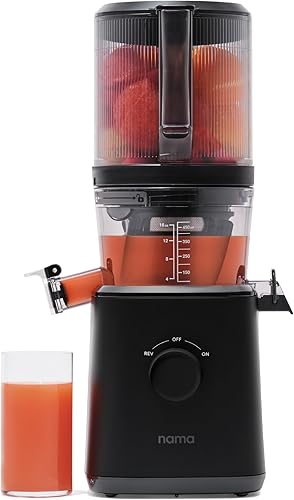
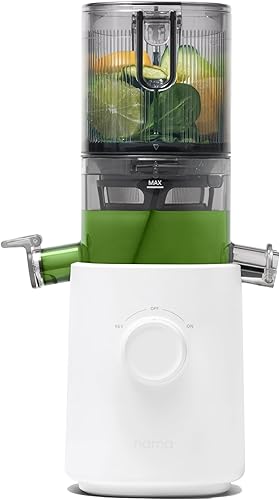
The J2 is black, measures 9 x 9.8 x 17.7 inches and weighs 12.1 pounds. The J3 is white, measures 6.5 x 8.9 x 15.4 inches and weighs 9.7 pounds.
Nama J2 vs Nama J3: which one wins overall?
The Nama J2 wins overall for regular home juicing. Its larger 1.9-pound capacity, 200 W motor and included juice containers, strainers and guides give it a wider margin for larger recipes.
The Nama J3 earns the better choice for a compact kitchen. Its 15-fluid-ounce capacity is smaller, but the 6.5 x 8.9 x 15.4-inch body takes up less counter space than the J2.
Both models operate at 50 RPM and have 1 speed. That means the J3 is not a faster version of the J2.
The key differences are body size, capacity, motor power, weight, color and some included components.
Both are corded electric machines with hand-wash care. Both are designed around hands-free feeding, so the basic workflow is similar: prepare the produce, load the hopper, allow the juicer to process it, then clean the removable parts.
How do the Nama J2 and J3 compare side by side?
The J2 is larger and more powerful, while the J3 is smaller and lighter. The best match depends on whether you value larger loads or easier storage.
| Product | Best for | Capacity | Size (D x W x H) | Motor | Our score |
|---|---|---|---|---|---|
| Nama J2 Hands-Free Juicer | larger batches | 1.9 pounds | 9 x 9.8 x 17.7 in | 200 W, 50 RPM | 8.5 |
| Nama J3 Compact Hands-Free Juicer | small kitchens | 15 fluid ounces | 6.5 x 8.9 x 15.4 in | 130 W, 50 RPM | 7.9 |
The J2 has a 1.9-pound capacity. That is a useful fit for people who prepare a full recipe in one session and want the hopper to hold more produce before the machine finishes processing it.
The J3 has a 15-fluid-ounce capacity. That smaller size suits a single smaller serving or a routine where you prefer to prepare less at a time.
Their motor ratings also separate them. The J2 has a 200 W motor, and the J3 has a 130 W motor.
Both operate at 50 RPM, so the J2's advantage is motor power rather than a higher stated speed.
The J2 is made from plastic and has a painted black finish. The J3 uses stainless steel and Tritan and has an uncoated white finish.
These material details help distinguish the models, but they don't change the basic hands-free style.
Which juicer is better for a larger recipe?
Choose the Nama J2 for larger recipes. Its 1.9-pound capacity is much more suitable for loading a fuller batch than the J3's 15-fluid-ounce capacity.
The J2's self-feeding hopper lets you load an entire recipe at once. Its product details also describe a wide-mouth hopper that fits a whole recipe, so the design is aimed at reducing the need to add produce one piece at a time.
That workflow helps when you are preparing juice while doing another kitchen task. You still need to prepare ingredients in a suitable way, keep the machine on a stable surface and follow its normal care routine.
The J2 also has the higher 200 W motor rating. Since both machines run at 50 RPM, the J2's stronger motor gives it the more suitable profile for a household that regularly handles bigger loads.
The J2 includes a juice container, juice container lid, pulp container, juice strainer, coarse strainer, pusher, spinning brush, auger, chamber, hopper, hopper lid and detachable power cord. That set supports a more complete batch-juicing setup.
Which model fits a small kitchen?
Choose the Nama J3 for a small kitchen. Its 6.5-inch depth, 8.9-inch width and 15.4-inch height make it smaller in every listed direction than the J2.
The difference is easy to picture on a counter. The J3 is 2.5 inches narrower, 2.5 inches less deep and 2.3 inches shorter than the J2.
That smaller body can make storage easier when you need to move the juicer after use. At 9.7 pounds, the J3 is also 2.4 pounds lighter than the J2.
A compact body does come with a smaller capacity. The J3 holds 15 fluid ounces, so it is better for smaller juice routines than for loading a large recipe.
The J3 is also described as compact and portable. That makes it the practical choice for someone who wants hands-free juicing but has limited counter space or needs a lighter appliance to store between sessions.
For more models with this style, see our guide to hands free juicer options. It can help you compare the space-saving idea with other self-feeding designs.
Does motor power matter between the J2 and J3?
The Nama J2 has the motor advantage, with 200 W compared with 130 W in the J3. Both use 50 RPM and 1 speed, so motor power is the clearest performance-related difference in the supplied specifications.
A 200 W motor gives the J2 the stronger specification for a household that makes larger recipes or juices often. It matches the J2's larger 1.9-pound capacity and wider-mouth hopper.
The J3's 130 W motor fits its compact purpose. Its 15-fluid-ounce capacity means you are asking it to handle smaller loads, and its smaller body is easier to keep in a tight kitchen.
Neither model gives you a choice of multiple speeds. The single-speed setup keeps the controls simple, while the 50 RPM operation places both in the slow-press category.
If your priority is the most capable combination of capacity and motor power, pick the J2. If your priority is a smaller machine for modest servings, the J3's lower motor rating is part of a compact design rather than a reason to choose it for large batches.
What produce can each juicer handle?
The Nama J2 and J3 both suit fruit and vegetable juicing, while the J3 also names leafy greens and nuts among its recommended uses. Choose based on your routine, then prepare each ingredient for the machine's normal feed path.
The J2 is described for fruits, vegetables and leafy greens. Its design is also intended to process leafy greens and other produce while maximizing juice output with less waste than traditional juicer machines.
The J3 is recommended for fruits, vegetables, leafy greens and nuts. Its slow pressing speed is described as minimizing oxidation and heat while preserving natural flavor and nutrients.
Those statements describe the intended use and design claims, not a promise about every recipe. A thick, fibrous or unusually large ingredient still needs sensible preparation before it goes into a juicer.
For either model, organize the recipe before switching the machine on. Put the produce within reach, use the hopper as intended, and keep the juice and pulp containers positioned correctly.
The J3's smaller capacity favors a short recipe. The J2 is the stronger match for a larger mix of fruits, vegetables or leafy greens in one hands-free session.
Which one is easier to assemble and clean?
Both models are designed for easy assembly and hand-wash care. The J2 has quick-release parts and includes a cleaning brush, while the J3 also has quick-release parts, easy assembly and a cleaning brush.
The J2 comes with juice containers, strainers and guides as part of its all-in-one setup. Its included components list also names a coarse strainer, juice container lid and pusher.
The J3 includes a juice container, pulp container, juice strainer, coarse strainer, spinning brush, auger, chamber, hopper and detachable power cord. It also includes a recipe book.
A simple routine helps either model stay manageable. Separate the removable parts after use, rinse away remaining pulp, wash the parts by hand and use the brush where residue collects.
The hand-wash instruction applies to both products, so these are not appliances to treat as dishwasher-first equipment. Set the parts out to dry before putting the juicer away.
The J2 has a larger body and more listed components, while the J3 has fewer listed dimensions and a lighter frame. Choose the J3 if moving and storing the machine is part of your cleanup routine.
Who should buy the Nama J2?
Buy the Nama J2 if you juice for larger recipes, want the stronger motor rating or prefer a fuller included setup. It is the better pick for most households that plan to use a hands-free juicer often.
The 1.9-pound capacity is the main reason to choose it. It gives the J2 a better fit for a recipe that would feel cramped in a 15-fluid-ounce machine.
The 200 W motor adds another clear advantage over the J3's 130 W motor. Since both operate at 50 RPM, the J2's value comes from combining that motor with the larger capacity rather than from running faster.
The J2's 12.1-pound weight and 17.7-inch height are real trade-offs. It needs more room on the counter and takes more effort to move than the J3.
Pick the J2 when your kitchen has a stable place for a taller appliance. The black finish, 1 speed, corded electric power and hand-wash care make it a straightforward everyday machine for a larger juicing routine.
Who should buy the Nama J3?
Buy the Nama J3 if your kitchen is small, your servings are modest or you need a lighter juicer. Its compact 15.4-inch height and 9.7-pound weight make it the easier model to store and move.
The J3's 15-fluid-ounce capacity sets the right expectation. It is a better match for a smaller juice routine than for someone who wants to load a large recipe and process it in one session.
Its 130 W motor is lower than the J2's 200 W rating, but both models operate at 50 RPM. The J3 keeps the same slow-press speed while using a more compact body.
The J3 is recommended for fruits, vegetables, leafy greens and nuts. Its white finish, stainless steel and Tritan materials, detachable power cord and hand-wash care suit a buyer who wants a compact appliance with a simple setup.
Choose it when counter space has the final say. If you have room for the J2 and regularly prepare larger batches, the J2 remains the better overall purchase.
What should you know before choosing between them?
Choose by capacity first, then use size and motor power to settle the decision. Capacity tells you how much the juicer is built to hold, while dimensions tell you whether it will fit your kitchen.
The J2 is the clear choice for larger batches. The J3 is the clear choice for smaller spaces and lighter handling.
Both have 15-year warranties, 50 RPM operation and 1 speed. Both use corded electric power, both are designed for easy cleaning and both support hands-free feeding.
The J2's recommended uses include juice, sauce, smoothies and sorbet. The J3's recommended uses include fruits, vegetables, leafy greens and nuts.
Those lists point to slightly different stated use profiles, so match the model to the recipes you plan to make.
If you are comparing the J2 with another large hands-free machine, read our Nama J2 vs Kuvings AUTO10 comparison. For another compact juicer category, our EanOruus juicer reviews offer a related comparison point.
Nama J2 vs Nama J3: which should you buy?
The Nama J2 is the winner for most readers. Its 1.9-pound capacity and 200 W motor give it the better combination for regular juicing, larger recipes and hands-free batch preparation.
Pick the Nama J3 when your priority is a smaller appliance. Its 15-fluid-ounce capacity, 9.7-pound weight and 6.5 x 8.9 x 15.4-inch size make it the better fit for a compact kitchen or smaller servings.
The decision rule is simple: choose the J2 for capacity and motor power, and choose the J3 for size and portability. Both run at 50 RPM, use 1 speed and support hand-wash care, so those features do not decide the matchup.
For a reader searching nama j2 vs nama j3, the J2 is the stronger overall answer. The J3 is the focused choice for anyone who needs the smaller body more than the larger batch capacity.
Frequently asked questions
Which Nama juicer is easier to move?
The Nama J3 is easier to move because it weighs 9.7 pounds, while the Nama J2 weighs 12.1 pounds. The J3 also has the smaller body, measuring 6.5 x 8.9 x 15.4 inches compared with the J2 at 9 x 9.8 x 17.7 inches.
Do the Nama J2 and J3 use the same speed?
Yes. Both juicers operate at 50 RPM and have 1 speed.
Their main performance difference is motor power: the J2 has a 200 W motor, while the J3 has a 130 W motor.
Which Nama juicer has the bigger juice capacity?
The Nama J2 has the larger capacity at 1.9 pounds. The Nama J3 has a 15-fluid-ounce capacity, so it suits smaller servings and shorter juicing sessions.
Can the Nama J3 process leafy greens?
Yes. The Nama J3 is recommended for fruits, vegetables, leafy greens and nuts.
The Nama J2 is also designed to process leafy greens and other produce for juice.
Are the Nama J2 and J3 easy to clean?
Both models have quick-release parts, easy assembly and hand-wash care. The J2 includes a cleaning brush, while the J3 includes a cleaning brush along with its juice container, pulp container and strainers.