Hurom H320 vs Nama J2: Which Juicer Fits You? (November 2026)
Pick the Nama J2 if you want low pulp and the least prep; pick the Hurom H320 if you want to control pulp texture and feed a busy family's juicing through steady refills. This Hurom H320 vs Nama J2 comparison weighs those gaps against how much produce you push through each week.
On this page (8 sections)
- Hurom H320 vs Nama J2: the quick verdict
- Side by side: Hurom H320 and Nama J2 compared
- Which juicer leaves less pulp in the glass?
- Which hopper and capacity suit a busy kitchen?
- Which is easier to clean and keep running?
- Which juicer is better for leafy greens?
- Which juicer fits your counter and cabinet?
- Which should you buy?
Pick the Nama J2 if you want low pulp and a load-and-walk-away routine; pick the Hurom H320 if pulp control and steady family feeding matter more. The Hurom H320 vs Nama J2 choice is mostly about how much you want to adjust, not raw power.
Both are self-feeding cold press juicers, so neither makes you push produce down a narrow chute. That shared ground makes the differences easier to see.
The Nama J2 scores 8.5 and the Hurom H320 scores 7.9 in our comparison. Our score weighs specs, features and buyer feedback against what you're shopping for.

Hurom H320 vs Nama J2: the quick verdict
The Nama J2 wins for most readers because it combines high yield, quiet running and a 15-year warranty in one simple routine. Load the hopper, walk away, and pour juice with less pulp than a typical masticating juicer leaves.
That makes it the better buy for someone who juices greens, fruit and citrus a few times a week and doesn't want to fiddle with settings. The J2 runs at 50 RPM from a 200 W motor, and NAMA backs it for 15 years.
The Hurom H320 is the pick when pulp is a personal preference rather than a nuisance. A lever plus fine and coarse strainers let you move between a clear juice and a thicker, more textured pour.
If you already know you like some body in your juice, the H320's 7.9 score reflects what it adds.
The deciding factor is rarely motor size. It is whether you want the machine to make the pulp call or to hand that call back to you.
Side by side: Hurom H320 and Nama J2 compared
Both machines self-feed whole produce; the Nama J2 leans on yield and warranty, and the Hurom H320 leans on pulp control and family-size feeding. Here is how the specs line up.
| Feature | Hurom H320 | Nama J2 |
|---|---|---|
| Feed | Family-size self-feeding hopper | Self-feeding hopper |
| Motor | 240 W | 200 W |
| Speed | Slow squeeze auger | 50 RPM |
| Pulp control | Lever, fine and coarse strainers | Juice strainer and coarse strainer, no lever |
| Juice capacity | 0.5 liters | Includes juice container |
| Footprint | 8 x 8 x 16 in | 9 x 9.8 x 17.7 in |
| Cleaning | Easy assembly, hand wash | Quick-release parts, brush included |
| Score | 7.9 | 8.5 |
The table shows how close the two sit. The Hurom lists a higher wattage, but wattage isn't a yield figure, and the J2's slower, steadier squeeze is built for the same job.
The clearest split is the strainer setup. Hurom gives you two strainers and a lever; Nama gives you one path that's already tuned for low pulp.
If you're still weighing other self-feeding brands, the Nama J2 vs Kuvings AUTO10 hands-free juicer comparison shows how these designs differ once a third hopper enters the room.
What each machine ships with
The J2 box holds the detachable power cord, chamber, hopper and lid, spinning brush, auger, juice container and lid, pulp container, juice strainer, coarse strainer and pusher. You get a complete setup with a storage lid and a pulp bin already in the kit.
Hurom's H320 centers on the strainers and the pulp control hardware rather than a long component list. If you want everything spelled out in one box, the J2 does that more clearly.
Motor, speed and what each figure means
Hurom's 240 W and Nama's 200 W are close enough that neither should drive the purchase. The J2's 50 RPM is a genuine slow press figure, and NAMA describes it as quiet operation.
Hurom describes patented Slow Squeeze technology and an auger that squeezes produce like a hand-squeezer, with a near-silent motor. The practical difference is less about which motor wins and more about whether the speed is paired with pulp hardware.
Which juicer leaves less pulp in the glass?
The Nama J2 is the low-pulp pick, while the Hurom H320 lets you choose how much pulp stays. That's the first real decision point between them.
NAMA designed the J2 to process leafy greens and produce with less waste, and the result is high-yield juice with less pulp. There's no lever to set, so every batch follows the same path.
The H320 takes the opposite approach. Its control lever and fine and coarse strainers let you shift between a cleaner pour and a thicker one, and Hurom says the auger squeezes produce like a hand-squeezer, leaving bone-dry pulp.
Both machines aim for dry pulp, but the H320 hands you the tuning knob and the J2 makes the choice for you. Choose the H320 if you juice the same produce two ways, such as clear apple juice for one person and a pulpy carrot-orange blend for another.
Skip the extra control if you already know you like a clean glass, since a lever you never move is just another part to wash.
The strainer setup in plain terms
The J2 includes a coarse strainer alongside the juice strainer, and the result is high yield with less pulp rather than a dial you adjust. The H320 is the opposite.
Fine and coarse strainers plus a control lever make pulp an adjustable setting. If texture is something you tune recipe by recipe, the Hurom hardware is the reason to look its way.
Which hopper and capacity suit a busy kitchen?
The Hurom H320 suits steady family refills, and the Nama J2 suits loading one full recipe and leaving it. Both save chopping; they differ in how you keep feeding them.
Hurom builds the H320 around a high-volume self-feeding hopper that fits whole produce. Its larger opening and inlet accept more ingredients even while the juice maker is still running.
That design rewards a cook who stands nearby, tops up the hopper and works through a counter full of produce. A large batch of greens and root vegetables settles well into that rhythm.
The J2 is tuned for a different habit. You load your entire recipe at once, then leave to multitask while it processes.
The trade-off is that a refill means stopping to open the hopper again. Count how often you juice big batches, and match the hopper to the way you actually work.
Juice reservoir and batch size
Hurom lists a 0.5-liter capacity, so the juice cup fills and needs emptying during a long session. The J2 ships with its own juice container and lid as part of the included set.
Plan a second cup if you push large greens through either juicer. Both expect you to empty as you go.
The type of produce each machine expects
Hurom lists apple, beetroot, carrot, celery, cucumber, ginger, grape, grapefruit, kale, lemon and orange for the H320. That covers fibrous roots, leafy greens and citrus in one list, which is why the pulp lever earns its keep across a varied fridge.
The J2's recommended uses are juice, sauce, smoothies and sorbet. Sorbet is notable here, because the J2 covers frozen dessert without a second machine.
Neither lists nut milk, which is the gap that sends some shoppers toward a 3-in-1 instead.
Which is easier to clean and keep running?
The Nama J2 edges ahead on cleanup because its quick-release parts come with a cleaning brush, while the Hurom H320 relies on easy assembly. Both are hand wash only.
The J2's components release quickly, and the brush handles the strainer and auger without you hunting for a tool. The H320 is no slouch either.
Hurom highlights easy assembly and cleaning, and the machine comes apart for washing without drama. Rinse the parts before the pulp dries, wash by hand, and dry fully before reassembly.
Both makers stress quiet running, which helps if you juice before the house wakes.
For more comparison points across brands, our Canoly vs EanOruus 3-in-1 juicer post looks at machines with even more strainer options.
Warranty and peace of mind
NAMA backs the J2 with a 15-year warranty. The Hurom H320 doesn't come with a published warranty term.
A long warranty changes how you think about a daily-use appliance. If you plan to juice for years and want the maker on the hook for a decade and a half, the J2's 15 years is a strong signal.
If you switch machines often, it matters less.
Which juicer is better for leafy greens?
The Hurom H320 is the more flexible leafy-green machine because its coarse and fine strainers let you tune the pour; the Nama J2 is the set-and-forget option. Kale, spinach and wheatgrass are where the two part ways.
Hurom names kale among the produce the H320 handles, and its slow squeeze is built to press chewy greens without scorching them. The strainers let you decide whether you want a light green juice or a thicker one.
The J2 is also tuned for leafy greens, and NAMA says it processes them efficiently. Because there's no strainer switch, every green batch comes out the same way, which suits people who found their favorite setting once and stuck with it.
If you run greens daily, decide which habit fits. Do you want to adjust for each recipe, or one reliable result every time?
Yield and oxidation over time
Hurom makes a specific freshness claim: Slow Squeeze minimizes oxidation, and the design extracts every last drop, with juice that stays fresh up to 72 hours. That matters if you juice in batches and drink over several days.
NAMA's yield claim is about extracting more from each ingredient and processing leafy greens efficiently with less waste. The J2 doesn't state a storage window.
If you drink your juice the same morning, that difference narrows.
Which juicer fits your counter and cabinet?
The Hurom H320 takes less counter space, and the Nama J2 is slightly larger and lighter to lift. Measure before you commit a corner to either one.
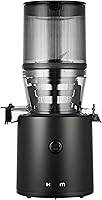
The H320 measures 8 x 8 x 16 inches, a compact footprint for a family-size hopper. It weighs about 21 pounds, so lifting it to a cabinet is a two-hand job.
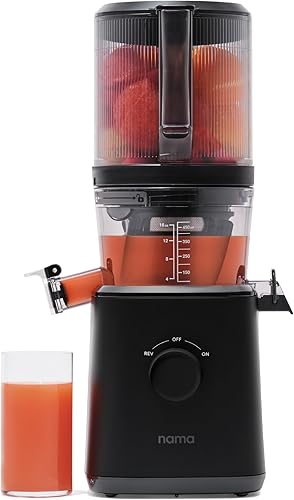
The J2 measures 9 x 9.8 x 17.7 inches and weighs 12.1 pounds. That's a lighter cabinet lift despite a bigger base.
Check the height against your upper cabinets. A self-feeding hopper needs clearance to open, and a tall unit under a low shelf is frustrating even when the closed box fits.
Neither machine needs plumbing. Both run from a corded outlet, so plan a spot near a socket and a sink.
The H320 arrives in kale or dark green with an uncoated plastic finish; the J2 comes in black with a painted finish. Neither is stainless steel, so both ask for a wipe-down to keep the look clean.
Which should you buy?
Buy the Nama J2 if you want low pulp, a quieter routine and long warranty coverage; buy the Hurom H320 if pulp control and a compact family hopper matter most. That's the Hurom H320 vs Nama J2 decision in one line.
The J2 earns its 8.5 score by removing decisions. A simple fixed strainer setup, a load-and-leave hopper and a 15-year warranty make it the easier machine to live with for most kitchens.
The H320's 7.9 score reflects a narrower appeal with real value. If you switch between clear and textured juice or feed the hopper through a big family batch, its lever and two strainers do work the J2 doesn't.
If nut milk or frozen sorbet is part of your plan, look at a 3-in-1 machine instead. Our Ninja vs AMZCHEF juicer comparison covers that category, and the Nama J2 juicer vs Hurom H400 post shows how the J2 stacks up against Hurom's larger family model.
For most readers, the J2 is the pick. Choose the H320 only if you'll actually use its pulp settings.
Frequently asked questions
Which is better for beginners, the Hurom H320 or the Nama J2?
The Nama J2 is easier for a beginner because there is one strainer and one way to run it. The Hurom H320 asks you to choose fine or coarse and adjust the lever, which pays off once you know how much pulp you like.
Can both juicers handle whole apples?
Yes, both have self-feeding hoppers built for whole produce, so you can skip most chopping. Large items still need to fit the inlet; cut anything that won't drop in cleanly.
Which juicer suits a family?
The Hurom H320 is built around family batches, with a high-volume hopper and an inlet you can keep feeding while it runs. The Nama J2 also takes a full recipe at once, but its strength is a load-and-leave routine rather than steady refills.
Do both juicers need hand washing?
Yes, both are hand wash only. The Nama J2 has quick-release parts and a cleaning brush, while the Hurom H320 spotlights easy assembly and cleaning.
Neither goes in the dishwasher.
Does the Nama J2 make sorbet or nut milk?
Its recommended uses include sorbet, along with juice, sauce and smoothies. If nut milk and frozen dessert are a priority, a 3-in-1 machine like the EanOruus gives you dedicated strainers for both.